
Access MSUTR Data
Access MSUTR Data
We welcome inquiries from scientists interested in accessing the MSUTR for use in their own projects, whether as a resource for the identification and recruitment of participants or as a pre-existing source of data on health conditions, demographics, and behavioral characteristics of twins and their families. Researchers do not have to be researching twins to recruit individuals from our registry or analyze existing twin data.
Accessing The Registry
Researchers interested in using the registry are asked to submit a proposal that outlines the study aims, the target subject population, project timelines, and the resources needed. Proposals may be submitted for data analysis of existing data only, or for targeted recruitments from the registry. All proposals will be evaluated by the MSUTR Advisory Committee, particularly with regard to potential overlap in analyses and/or subject recruitment with other projects. Once approval is received, the MSUTR staff will work with the investigator to get all IRB and data use agreements in place, and then access to the data will be granted and/or the recruitment process will begin. However, please note that any data shared by the MSUTR will have personally identifying information removed, and any twins selected for recruitment into another study will be anonymous to the recruiting researchers until such time as they choose to participate in that study.
MSUTR Data Use Proposal Form - Analysis of existing data only
MSUTR Data Collection Proposal Form - New data collection/recruitment
Recruitment Overview
Twins may be selected for recruitment based on age, sex, twin type, and development status, in addition to the screening items listed on the health survey (please see chart below for a list). Investigators can then recruit twins via postal mail. Recruitment mailings will be prepared by MSUTR staff and delivered to the Michigan Department of Health and Human Services (MDHHS) for mailing, as the MDHHS houses vital records and address information for MSUTR twins. All of the recruitment materials include basic information about the study and provide instructions for twins/families to indicate their interest in participation through the return of postage-paid postcards or a survey link included in each mailing.
A series of four recruitment contacts are sent per twin/family. The fourth mailing is done using certified letters. Contacts are timed approximately 6-8 weeks apart, until all four contacts have been made. All four recruitment contacts must be completed (to those with no response), and all twins/families who express interest in the study and are eligible must be allowed the opportunity to participate, even if the target sample size for the project has been reached. Thus, the sample size chosen for each recruitment series should account for each of the four recruitment contacts, and the budget should be planned accordingly. These policies help promote a positive relationship with twins/families and provide consistency across studies, allowing for comparable response rates.
MSUTR staff prepare and facilitate the recruitment contacts, including printing any recruitment materials, assembling recruitment mailing packets, and delivering the packets to the MDHHS for mailing. MSUTR staff work closely with both the outside study staff and MDHHS staff to provide updates, adjust as necessary, and ensure the mailings go out on schedule and according to specifications.
Notably, the MSUTR staff only facilitate recruitment mailings; they are not involved in the contacting of twins to determine study eligibility, schedule assessments, etc. All direct contact and data collection with the twins/families are done by the outside, primary study investigators. Thus, once twins have indicated an interest in participation, the investigators of the study (not MSUTR staff) contact interested twins/families and proceed with study recruitment and assessments.
For studies that do not require in-person participation, the study questionnaire could be included with the initial recruitment mailings for participants to complete and return at their discretion. However, this may require more funds/money, if the questionnaire is mailed, as postal costs are proportional to the size of the mailing. Any such questionnaires must be provided by the outside researcher/primary study staff for inclusion in the mailings, and they must be returned directly to the primary investigators, not the MSUTR.

Registry Access Fees
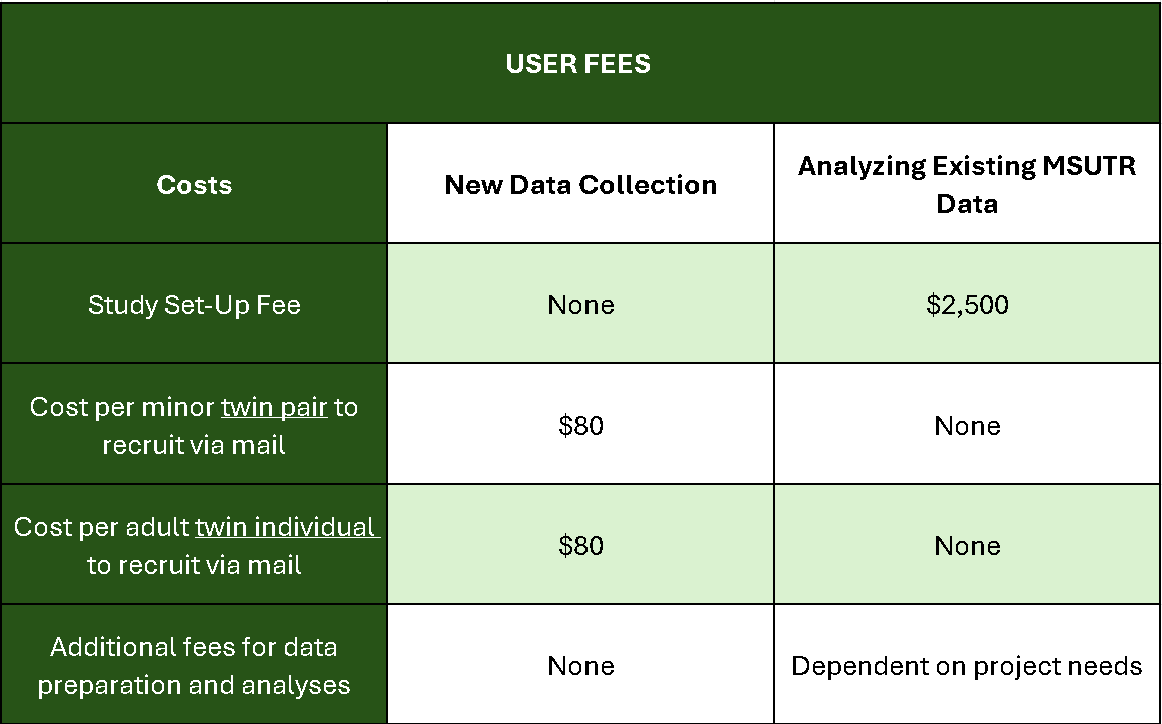
New Data Collection Projects: There are one-time data collection fees (see table below) that cover expenses associated with participant selection and recruitment mailings. These data collection fees cover all recruitment mailing expenses (e.g., copying recruitment materials, postage, mailing materials) and staff time at both MSU and MDHHS. Please note that costs are higher for the recruitment of adult than child twins since adult recruitment requires mailing two separate recruitment packets (one to each adult twin) whereas recruitment of child/adolescent pairs requires only one packet sent to the twins’ parents. Researchers are billed after the 4th mailing goes out. As noted above, all investigators must contact each twin/family four times to maximize response rates and ensure judicial use of twin registry resources.
Analyzing Existing MSUTR Data: For analysis of existing MSUTR data, there is a different fee structure. At the start of the project, investigators are charged a flat fee of $2,500 to cover personnel time in probing the MSUTR dataset for variables for the project and developing data use agreements and any needed IRB applications. This flat rate is set to equate to staff time of ~4 hours/week for 6 months, which is the amount of time it generally takes to get a new MSUTR data analysis project off the ground. Additional fees are charged once all approvals are in place and it is time for the data to be extracted. These fees are estimated based on each individual project’s needs (e.g., number of variables to be extracted; data manipulations needed prior to extraction; help with analyses from the data manager or Co-Directors) and the estimated MSUTR personnel time, using the base salary and number of expected hours for the fee calculation.
Contact Us
If you are interested in accessing the MSUTR for use in your own project, or you would like to learn more about the MSUTR, please Contact Us!